"I have PP regrind."
That may be enough to start a conversation, but it is not enough for a buyer to determine whether the material works for their operation.
The same applies to a request such as, "Looking for recycled HDPE." A supplier still needs to know the grade, specifications, quantity, location, timing, and commercial requirements before deciding whether they can fill it.
A complete plastic resin offer or request should include the material type, grade, form, condition, relevant specifications, quantity, packaging, location, availability, commercial terms, photos, and supporting documents. The goal is to give the other party enough information to determine whether there is a potential fit without requiring five rounds of follow-up questions.
Better information creates better matches, faster quotes, and fewer surprises once a deal starts moving.
What Is the Difference Between a Plastic Resin Offer and a Request?
A plastic resin offer describes material that a seller has available.
A plastic resin request describes material that a buyer wants to purchase.
Both should contain the same basic categories of information, but the emphasis is different.
An offer should clearly explain:
- What the material is
- What condition it is in
- How much is available
- Where it is located
- When it can ship
- What the seller expects from the transaction
A request should clearly explain:
- What material the buyer needs
- Which specifications are required or acceptable
- How much the buyer needs
- Where it needs to be delivered
- When it is needed
- Which commercial or operational requirements must be met
The more specific the information, the easier it is for the market to respond accurately.
What Information Should Be Included in a Plastic Resin Offer or Request?
A strong plastic resin offer or request should cover the following ten areas.
1. Material Type and Resin Family
Start with the basic identity of the material.
Examples may include:
- Polypropylene, or PP
- High-density polyethylene, or HDPE
- Low-density polyethylene, or LDPE
- Linear low-density polyethylene, or LLDPE
- Polyethylene terephthalate, or PET
- Acrylonitrile butadiene styrene, or ABS
- Polycarbonate, or PC
- Nylon
- Polystyrene
- Thermoplastic elastomers
- Engineering-grade resins
Avoid relying only on broad descriptions such as "mixed plastic," "recycled material," or "polyethylene."
Those descriptions may be accurate, but they do not provide enough information for a buyer or supplier to evaluate the opportunity.
2. Grade, Manufacturer, and Trade Name
Include the grade, manufacturer, and trade name when they are known and relevant.
For example:
- Manufacturer and specific grade
- Generic prime equivalent
- Injection, extrusion, film, blow molding, or rotational molding grade
- Homopolymer or copolymer
- Filled or unfilled
- Reinforced or unreinforced
- Impact-modified or standard
For an offer, this helps buyers determine whether the material fits an existing process or approved formulation.
For a request, it is important to clarify whether the buyer needs an exact grade or will consider alternatives with comparable properties.
A request that says "Brand X Grade 123 only" is very different from one that says "Brand X Grade 123 or an approved equivalent."
That distinction can significantly expand or narrow the available supply.
3. Material Form and Condition
State what physical form the material is in and how it should be classified.
Common descriptions include:
- Pellets
- Regrind
- Reprocessed pellets
- Flake
- Bales
- Powder
- Purge
- Parts
- Film
- Lumps
- Scrap
The condition should also be clear:
- Prime
- Generic prime
- Wide-spec
- Off-grade
- Post-industrial recycled
- Post-consumer recycled
- Regrind
- Repro
- Mixed or commingled
Include color, cleanliness, consistency, known contamination, and source-material information when relevant.
"Natural PP regrind from a controlled post-industrial stream" tells a buyer much more than "PP regrind."
4. Relevant Material Specifications
The exact specifications will depend on the resin, application, and form of the material.
Information may include:
- Melt flow index or melt flow rate
- Density
- Intrinsic viscosity
- Moisture
- Ash content
- Filler percentage
- Glass-fiber percentage
- Impact strength
- Tensile properties
- Color
- Contamination levels
- Additive package
- PCR percentage
- Source composition
- Food-contact or regulatory status
An offer should include available test results and identify whether the information comes from a current certificate of analysis, technical data sheet, internal testing, or the seller's best knowledge.
A request should separate true requirements from preferences.
For example:
- Required MFI range: 8 to 12
- Preferred color: natural
- Black may also be considered
- Maximum contamination: 1%
- Food-contact approval not required
Giving an acceptable range can produce more options than specifying a single ideal number that may not be operationally necessary.
5. Quantity and Ongoing Availability
State the quantity clearly and use a consistent unit of measurement.
Include:
- Total pounds available or needed
- Number of truckloads, railcars, bales, or containers
- Minimum order quantity
- Whether partial quantities will be considered
- Whether the opportunity is one-time or recurring
- Expected monthly or annual volume
- Any quantity tolerance
A seller might have one truckload available immediately or 200,000 pounds available each month.
A buyer might need one trial load before committing to recurring volume.
Those are very different opportunities, even when the material specifications are identical.
For ongoing programs, explain the expected cadence.
Examples:
- One truckload per month
- Two railcars per quarter
- 100,000 pounds available immediately, followed by approximately 40,000 pounds per month
- Initial trial order of 10,000 pounds, with the potential to scale
6. Packaging and Loading Details
Packaging affects handling, freight, storage, and the buyer's ability to receive the material.
Specify whether the material is packaged in:
- Gaylords
- Super sacks
- 25-kilogram or 50-pound bags
- Boxes
- Drums
- Bales
- Bulk trucks
- Railcars
- Loose material
- Palletized containers
Include the approximate net weight per package and the number of packages when possible.
Relevant loading information may include:
- Dock or ground loading
- Forklift availability
- Live load or drop trailer
- Rail access
- Bulk loading capability
- Appointment requirements
- Loading hours
- Whether pallets are included
A competitive material price can quickly become less attractive when the packaging is incompatible with the buyer's operation or the loading requirements are discovered too late.
7. Material Location and Freight Terms
Location is one of the most important parts of any plastics offer or request.
Freight can determine whether an opportunity is commercially viable, particularly for lower-value materials.
Include:
- City and state
- ZIP code, when appropriate
- Country
- Origin facility or general region
- Delivery destination for a request
- FOB or delivered pricing basis
- Whether the seller can arrange freight
- Whether the buyer will manage transportation
- Export or cross-border considerations
A request should identify whether suppliers must be located within a certain region or whether material from anywhere will be considered if the delivered economics work.
An offer should make clear whether the stated price is FOB the seller's facility or includes transportation to a particular destination.
8. Timing and Availability
Explain when the material is available or needed.
For an offer, include:
- Available now
- Expected production date
- Earliest pickup date
- Deadline for removal
- Whether the inventory is subject to prior sale
- Expected duration of an ongoing stream
For a request, include:
- Required delivery date
- Desired start date
- Whether there is flexibility
- Whether the need is urgent, ongoing, or project-based
- Trial and qualification timing
Timing matters because a buyer with an immediate production need may not be able to wait for material that becomes available six weeks from now.
Likewise, a seller trying to clear warehouse space may value speed differently from a seller marketing a predictable monthly production stream.
9. Price and Commercial Terms
Not every initial offer or request needs to publish an exact price, but it should provide enough commercial direction to prevent obviously unworkable responses.
Information may include:
- Asking price
- Target price
- Price per pound, kilogram, metric ton, truckload, or railcar
- FOB or delivered basis
- Whether reasonable offers will be considered
- Minimum order
- Payment terms
- Sampling requirements
- Inspection requirements
- Quality-claim procedures
- Trial-order expectations
- Contract duration for recurring business
Avoid unclear language such as "priced to move" or "looking for the best price" without additional context.
The goal is not necessarily to reveal every negotiating position. It is to help serious counterparties determine whether a conversation makes sense.
10. Photos and Supporting Documents
Photos are especially important for recycled, off-grade, wide-spec, baled, regrind, and scrap materials.
Useful photos may show:
- The material itself
- Color and consistency
- Packaging
- Labels
- Pallets
- Bales
- Storage conditions
- Visible contamination
- Lot or production information
Supporting documents may include:
- Technical data sheet
- Safety data sheet
- Certificate of analysis
- Laboratory results
- Regulatory documentation
- Composition statement
- Certificate of origin
- Sustainability or recycled-content certification
- Sample-test results
- Previous processing information
The documents required will vary by transaction. The important thing is to make clear what is available and what still needs to be confirmed.
Additional Information That May Matter
Depending on the material and transaction, buyers and sellers may also need to communicate:
- Approved or prohibited end uses
- Export restrictions
- Geographic restrictions
- Confidentiality requirements
- Whether the company name can be disclosed
- Sample availability
- Qualification procedures
- Change-control requirements
- Traceability expectations
- Sustainability certifications
- Chain-of-custody documentation
- Whether the material has previously been processed
- Whether blends or substitute grades will be considered
Not every opportunity needs every field. The right level of detail depends on the material, value, application, and risk involved.
The standard should be simple: include enough information for a qualified counterparty to understand the opportunity, evaluate the likely fit, and identify the few remaining questions that actually matter.
Example of a Complete Plastic Resin Offer
Here is a fictional example:
Material: Black polypropylene regrind
Source: Post-industrial injection-molded parts
Condition: Clean, consistent production scrap
Form: Regrind
Color: Black
MFI: Approximately 12 to 16, test data available
Filler: Unfilled
Quantity: 40,000 pounds available immediately
Ongoing volume: Approximately 40,000 pounds per month
Packaging: Gaylords averaging 1,000 pounds each
Location: Columbus, Ohio
Price: Open to offers, FOB origin
Availability: Ready for pickup
Documents: Current lab results and material photos available
Other notes: Domestic end users preferred; sample available upon request
A buyer can quickly understand what is being offered and determine whether it is worth requesting a sample, reviewing the data, or discussing price.
Example of a Complete Plastic Resin Request
Here is a fictional request:
Material needed: Natural HDPE regrind or repro
Application: Non-food-contact injection molding
Acceptable sources: Clean post-industrial material
MFI: 6 to 10 preferred
Color: Natural preferred; light mixed color may be considered
Contamination: No metal, paper, PVC, or visible foreign material
Quantity: Initial trial of 10,000 pounds
Ongoing volume: Potential for 80,000 pounds per month
Packaging: Gaylords or super sacks
Delivery location: Richmond, Virginia
Timing: Trial material needed within three weeks
Pricing: Delivered pricing requested
Documents: Recent test data required
Other notes: Equivalent materials will be considered if specifications are comparable
Suppliers now know whether they have a likely match and what information to send in response.
Why Complete Plastics Offers and Requests Matter
Incomplete information creates friction at every stage of a transaction.
It leads to:
- More emails and phone calls
- Slower quotes
- Poorly matched counterparties
- Freight surprises
- Misunderstood quality expectations
- Repeated data entry
- Deals that fall apart after time has already been invested
Complete offers and requests produce better outcomes because buyers and sellers can make faster decisions using the same information.
They also create cleaner market data.
When materials are consistently described by grade, specifications, quantity, packaging, location, and terms, the market can compare similar opportunities more accurately. Over time, that makes it easier to understand what is available, what buyers need, and where real pricing is developing.
Create and Share Complete Offers and Requests With Matium
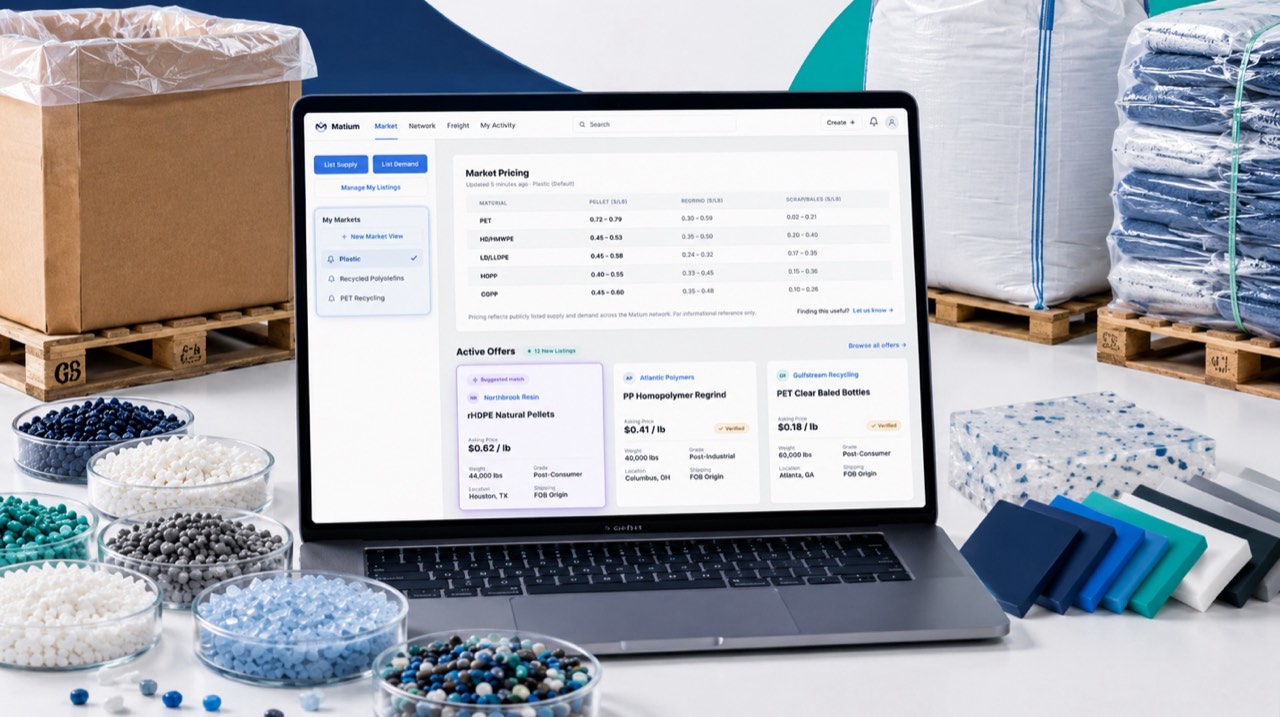
Matium is the materials trading platform where companies manage their market, find buyers and sellers, and run the transaction in one place.
A material record can include the grade, specifications, quantity, packaging, location, images, and documents needed to evaluate an opportunity. You can keep the information internal to your company, share it privately with selected people, or publish it to the Matium network.
The same record can then stay connected to the conversations, offers, direct deals, auctions, orders, freight, and transaction history that follow.
That means your team does not have to rebuild the same material information in a spreadsheet, email, quote, purchase order, and freight request.
Create the record once. Control who sees it. Share it wherever the conversation is happening.
Create a free Matium account and add your next offer or request.