Budapest, 21 October 2026
In August, Japan’s refineries produced 1,163,050 kilolitres (kL) of naphtha and the country imported 1,548,893 kL, 22% less than in August 2025: 2,711,943 kL of supply against 2,847,234 kL of domestic sales and 5,037 kL of exports. Month-end stocks fell 143,546 kL to 1,354,846 kL, 8.6% below August 2025. Imports were 57% of supply.
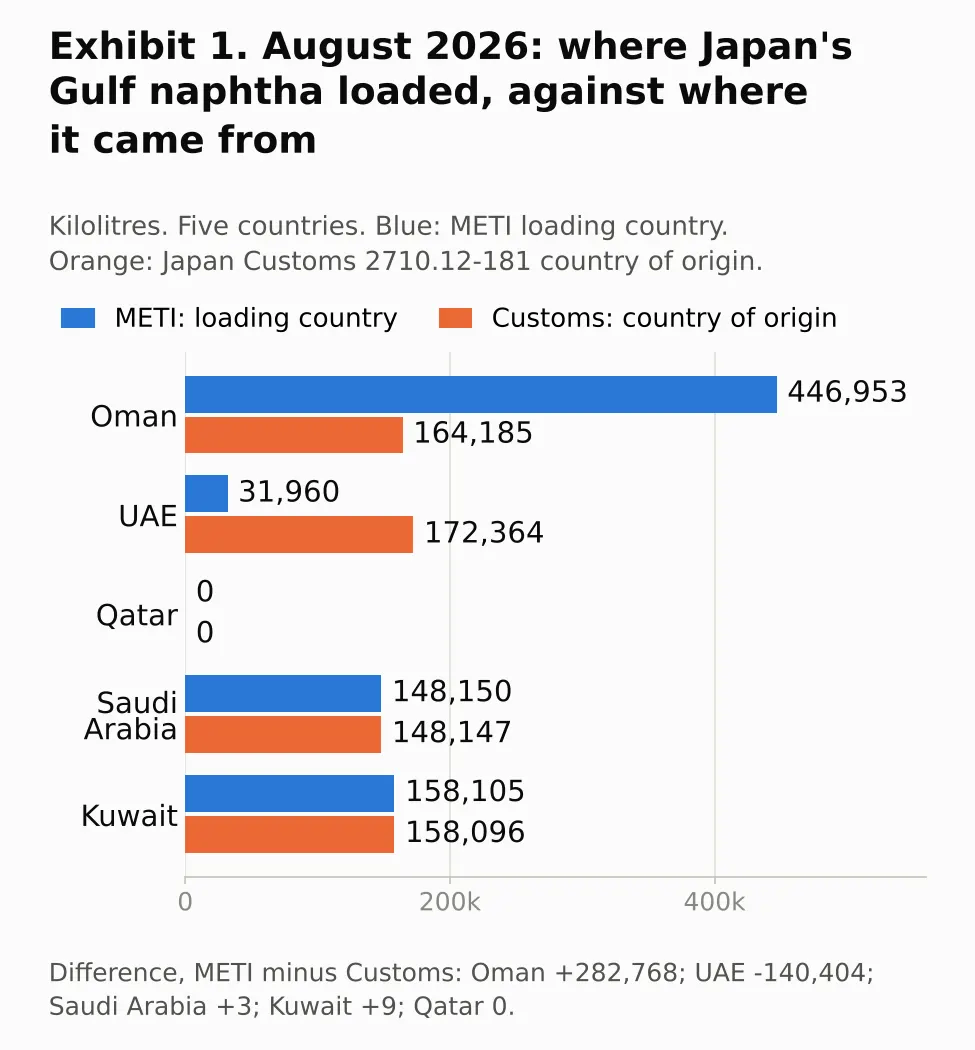
Where those imports loaded has changed. The Ministry of Economy, Trade and Industry (METI) survey asks importers for the country or region of the place of shipment, undefined further. For August it shows Oman at 446,953 kL, 29% of the month and the largest entry. Saudi Arabia, Kuwait and the United Arab Emirates together still account for 338,215 kL, so Oman leads the table without displacing the Gulf producers; it did not appear at all from January to May. The UAE, 382,493 kL in February, shows 31,960 kL in August. Qatar, 440,002 kL in January, shows nothing in July or August.
Japan Customs keeps a second series, by country of origin, under tariff line 2710.12-181. For August it records 164,185 kL of Omani origin and 172,364 kL of UAE origin. The two series rest on different definitions and recording dates; they need not agree, and in August they do not.
Freight moved while the supply map changed. Baltic Exchange route TC1, 75,000 metric tonnes (t) from Ras Tanura to Yokohama, was assessed at Worldscale 986 on 16 October against 517 on 14 August, roughly 1.9 times. TC15, 80,000 t Mediterranean to Far East, was 16.40 million dollars lumpsum on 16 October against 5.32 million in August, roughly 3.1 times; the August assessment was described as via Suez and the October routing is unconfirmed. Neither prices a cargo loaded in Omani waters.
On 11 October a 4,000 t coastal products tanker at Sohar anchorage was struck by a drone; two crew were reported missing. Reuters reported on 28 September that ADNOC had put about 1.5 million t of naphtha on 25 vessels for transfer off Sohar in August and September. Broker lists dated 16 October carry three 55,000 t naphtha cargoes, fixed or on subjects, for ship-to-ship loading at Sohar to Japan by month-end. On 21 October all three were declaring Fujairah anchorage on AIS (automatic identification system) signals, with no Sohar call or Japan destination shown; one had arrived, one signal was eight days old, one arrival time masked.
The position on 21 October: Oman leads Japan’s August loading table and rose as the other Gulf entries fell; the origin series shows a smaller rise in Omani product; stocks are below last year. Whether the same product moved between the two labels is the question the paid section tests. Nothing public shows how much product moved through Omani waters, whether any transfer was completed after 11 October, or what a Q1 cargo on that route costs delivered.
Paid subscribers get the June to August reconciliation for five Gulf countries, the eight-month loading matrix, the monitoring protocol for the 29 October, 30 October and 16 November releases, and the workbook with every figure sourced.
Views expressed by independent contributors are their own and do not represent Matium.