In materials trading, most deals don't break because of price.
They break because of freight.
A buyer agrees to a number.
A seller is ready to move product.
And then everything stalls while both sides try to figure out:
- What will it cost to ship?
- Who is booking the truck?
- How long will it take?
Freight is one of the biggest hidden bottlenecks in materials trading.
If you want to understand how deals actually move through the supply chain, it starts with how freight works.
How do freight quotes work in materials trading?
In most transactions, freight is handled manually.
Here's what that process typically looks like:
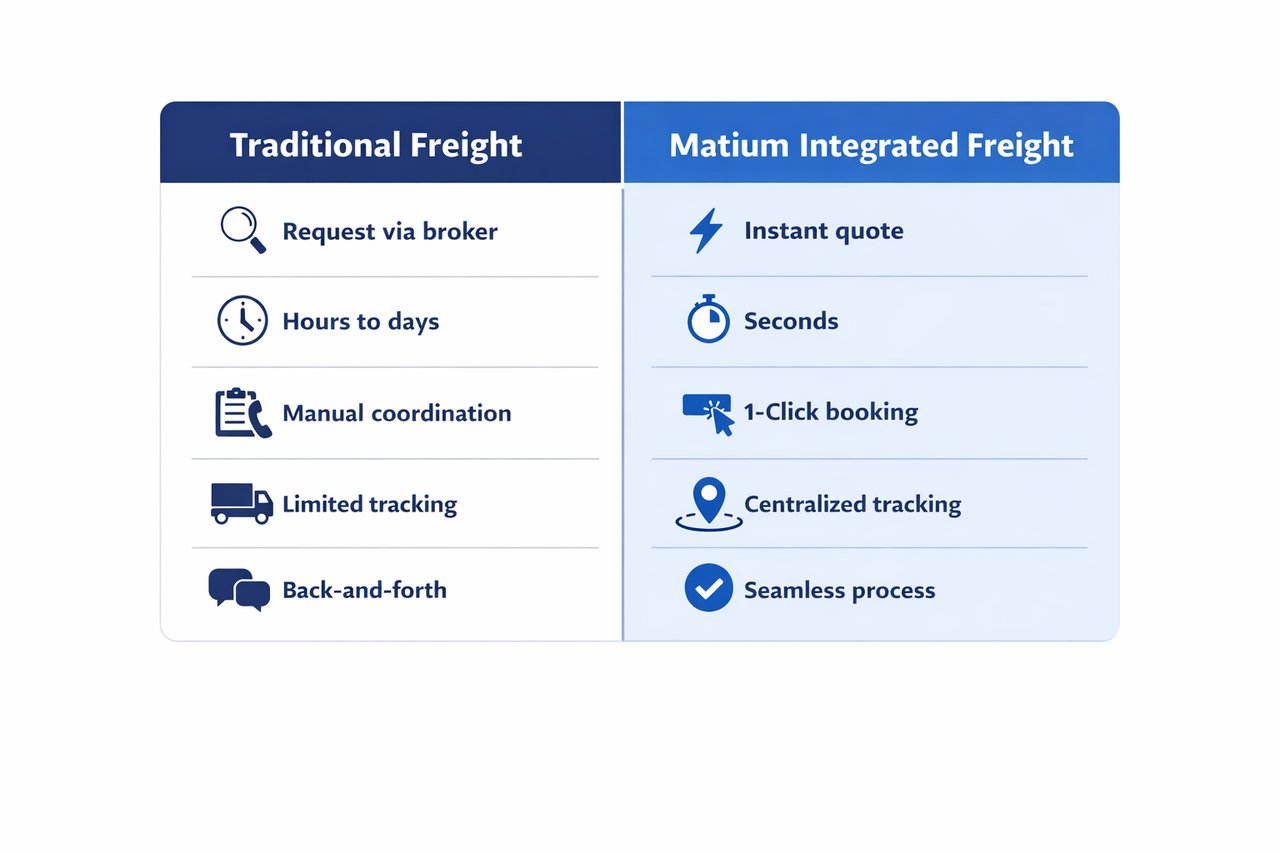
- Seller or buyer reaches out to a broker or 3PL
- Shipment details are shared (material, weight, origin, destination)
- Broker sources carriers and returns a quote
- Back-and-forth negotiation on pricing and timing
- Booking is confirmed manually
- Shipment is coordinated via email, phone, or spreadsheets
This process can take hours or even days.
And during that time, the deal is effectively on hold.
(If this sounds familiar, it's the same type of fragmentation seen in payment terms, which we recently covered in our guide on how trade financing works in materials markets.)
Why is freight such a bottleneck in materials markets?
Freight introduces uncertainty into every transaction.
1. Pricing isn't fixed
Freight rates change constantly based on:
- fuel costs
- lane demand
- equipment availability
- timing
Until a quote is locked, the deal isn't real.
2. It's disconnected from the transaction
Freight is usually handled outside the deal itself.
That means:
- separate conversations
- separate vendors
- separate timelines
Everything has to be stitched together manually.
3. It creates delays at the worst moment
Freight is often the last step before a deal closes.
So when it slows down:
- deals get delayed
- buyers lose interest
- sellers move inventory elsewhere
4. It adds operational overhead
For many teams, freight coordination means:
- multiple emails
- chasing updates
- managing carriers
- tracking shipments manually
It's time-consuming and hard to scale.
In fact, freight costs alone account for ~5–10% of total supply chain costs for most companies, and the time spent coordinating logistics is often just as expensive operationally. When that process is manual, it compounds quickly.
For a broader look at how freight and logistics function within the supply chain, see this overview from the U.S. Bureau of Transportation Statistics.
Traditional freight vs. integrated freight
Here's how most companies operate today compared to integrated infrastructure:
What does this mean for buyers and sellers?
For sellers
- Faster deal execution
- Less coordination overhead
- Fewer deals lost due to delays
For buyers
- Clear landed cost upfront
- Faster decision-making
- More confidence in timing
For both sides
- Fewer moving parts
- Less back-and-forth
- More deals actually closing
How Matium handles freight differently
At Matium, freight isn't an afterthought.
It's built directly into the deal.
All users, regardless of plan, can now:
- get instant freight quotes from trusted 3PL partners
- see shipping costs as part of the transaction
- book lanes in a single click
No waiting.
No back-and-forth.
No separate process.
This is part of a broader shift toward integrated infrastructure, where sourcing, pricing, financing, and logistics all happen in one place.
Explore how the Matium platform connects these workflows across the materials market.
What this unlocks
When freight becomes instant and integrated, a few things happen:
1. Deals close faster
No delays waiting on quotes.
2. More buyers qualify
Clear landed costs make decisions easier.
3. Less operational burden
Teams spend less time coordinating logistics and more time closing deals.
4. The "you just ship" model becomes real
Freight coordination is no longer on the critical path.
Example: before vs after
Before:
A seller finds a buyer → waits 24 hours for a freight quote → negotiates → risks losing the deal
After:
A seller sees freight instantly → includes it in the deal → books in one click → ships
That difference determines whether deals happen or don't.
Key takeaways
- Freight is one of the biggest hidden bottlenecks in materials trading
- Traditional freight processes are slow, manual, and disconnected from deals
- Instant quotes and integrated booking remove that friction entirely
- When freight moves faster, deals move faster
What to do next
If you're currently:
- waiting on freight quotes to close deals
- coordinating logistics manually
- losing time (or deals) to back-and-forth
It's worth seeing how integrated freight changes that process.
List your supply or explore the Matium network to see how freight fits directly into your transactions.
Frequently Asked Questions
How long does it take to get a freight quote for bulk materials?
Traditionally, freight quotes can take anywhere from a few hours to multiple days, depending on the lane, carrier availability, and broker responsiveness. On integrated platforms, quotes can be generated instantly based on real-time data.
What factors impact freight costs for plastics and resin shipments?
Freight costs typically depend on origin and destination, shipment size (truckload vs partial), fuel prices, carrier availability, and timing. These variables make manual quoting slow and inconsistent.
Why does freight delay materials deals?
Freight is often the final step before a deal closes. If pricing isn't clear or booking is delayed, buyers hesitate and sellers risk losing the transaction altogether.
Is there a way to get instant freight quotes for materials?
Yes. Platforms like Matium provide instant freight quotes by integrating directly with logistics partners, removing the need for manual broker outreach.
Can freight booking be done at the same time as the transaction?
Traditionally, no. Freight is handled separately. With integrated systems, freight can be quoted and booked within the same workflow as the transaction.
What's the benefit of integrating freight into a materials platform?
Integrated freight speeds up deal execution, reduces operational overhead, provides clear landed costs upfront, and removes coordination friction.