Broad oversupply matters for price forecasting. For a buyer preparing Q3 2026 nominations, it is much less useful.
A procurement team's exposure is not aggregate Asian capacity. It is a specific grade, supplier, origin, loading window, payment term and substitution clause.
A comfortable market narrative can still fail inside a real buyer file.
Offered volume isn't allocated volume.
That gap is what this week's paid pack exists to close.
The structural signal is real, but it is not a shortage call
Asia's naphtha-fed cracker system remains under pressure because margins are weak and capacity is being rationalized.
S&P Global Energy reported on 8 April 2026 that "Japan is expected to remove more than 25% of ethylene capacity by 2030, while South Korea is targeting a 20%-28% reduction in naphtha-fed steam-cracker capacity."
That doesn't prove a Q3 PE or PP shortage.
It does weaken the idea that regional length is enough comfort for a buyer's specific nomination file. A market can be long in aggregate while a buyer's approved grade, supplier route, loading window or substitution option remains exposed.
PRefChem and Hormuz need discipline, not panic
PRefChem is a large integrated Malaysian refining and petrochemical platform, and the ownership-transfer announcement is worth monitoring. Reuters reported that Aramco will transfer its PRefChem stakes to PETRONAS, making PRefChem wholly owned by PETRONAS subject to closing conditions. Aramco said PETRONAS assumes full ownership following the transfer, and that the two companies will continue exploring strategic cooperation.
That's material, but it isn't, by itself, a disruption signal, not unless supplier language changes.
Hormuz is also a live stress input. Reuters reported on 26 May 2026 that new US strikes had taken place as talks stalled. Reuters, citing Nikkei reporting, separately said the US and Iran were discussing a plan to open the Strait of Hormuz around 30 days after a deal to end hostilities.
For polymer buyers, the useful question is not whether the headline is dramatic. The useful question is simpler: has any of this shown up in your supplier's terms?
If it hasn't changed freight language, insurance wording, loading windows, allocation basis, substitution rights, payment timing or documentation, it stays a watch item. Don't let the headline write your nomination.
What the paid layer does?
The paid layer is the June/Q3 PE-PP Allocation Proof Pack.
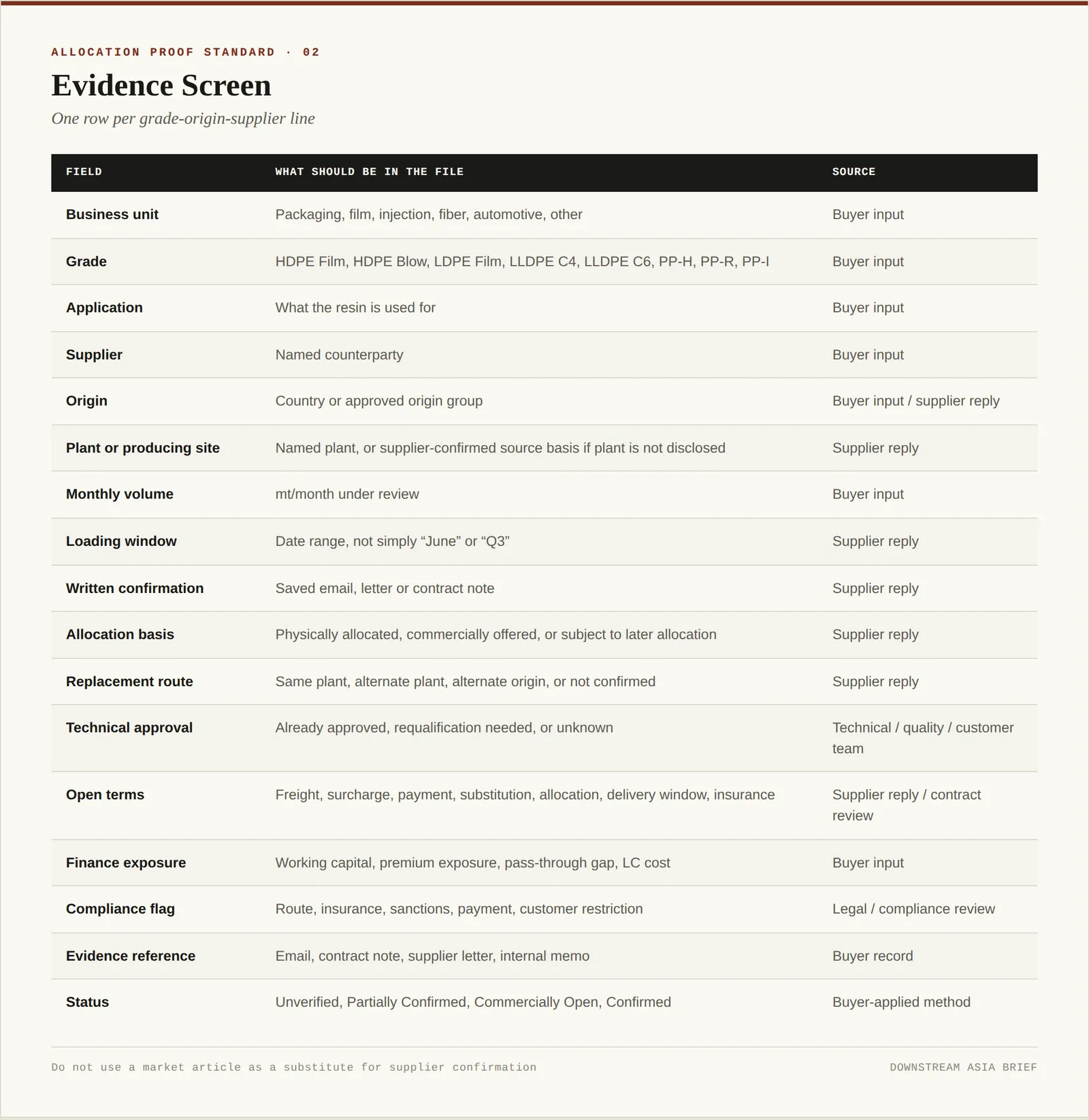
It gives buyers a structured way to separate commercially offered PE/PP volume from supplier-confirmed allocation before a nomination line is moved into internal confirmation.
The free post gives the argument.
The paid pack gives the working screen and supporting files.
Boardroom question
Before Q3 nominations are accepted internally, can your team separate commercially offered PE/PP volume from supplier-confirmed allocated volume?
If not, the risk is not only price, but it is procurement control.
Views expressed by independent contributors are their own and do not represent Matium.