Budapest, 11 August 2026
China's July customs print came in at 8.41 million b/d, up from 7.12 million in June. Read on its own that looks like the rebound starting. It is not enough to settle a September loading decision, and the reason sits in the refinery numbers rather than the import numbers.
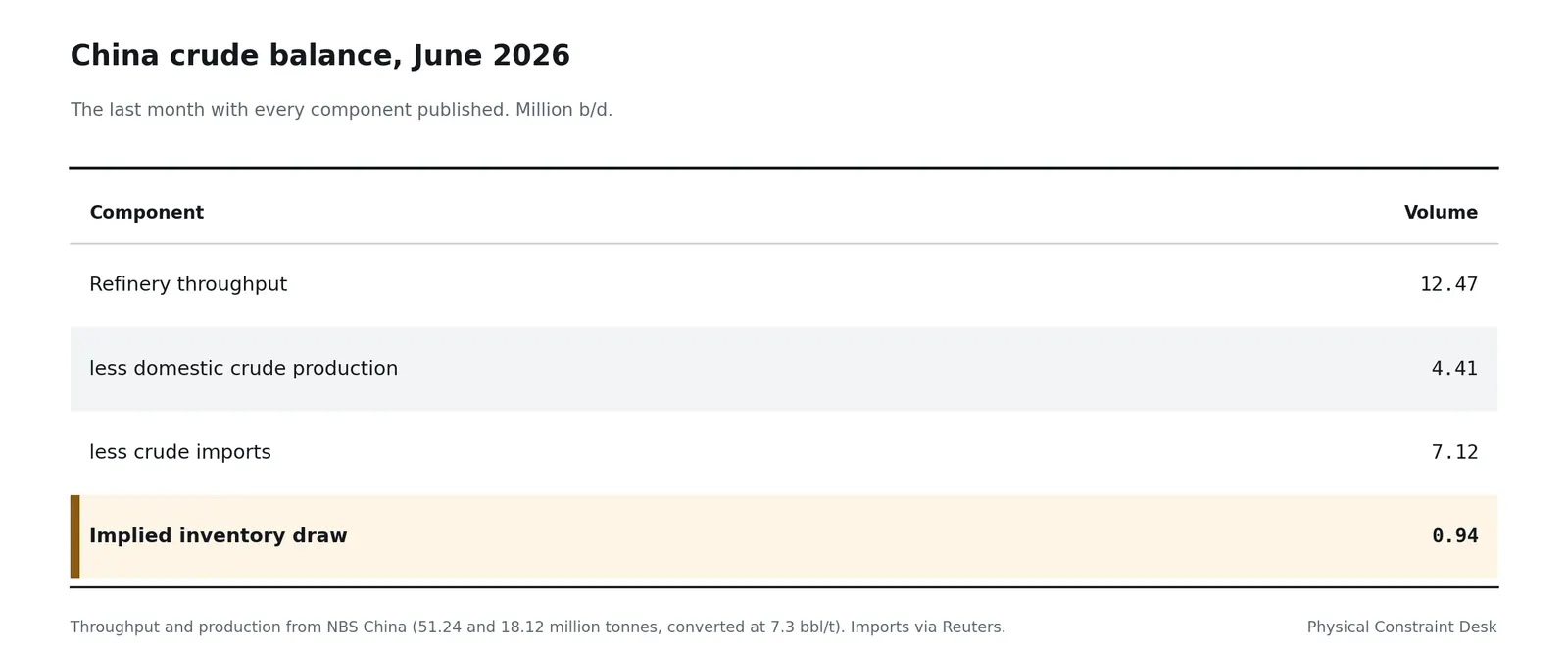
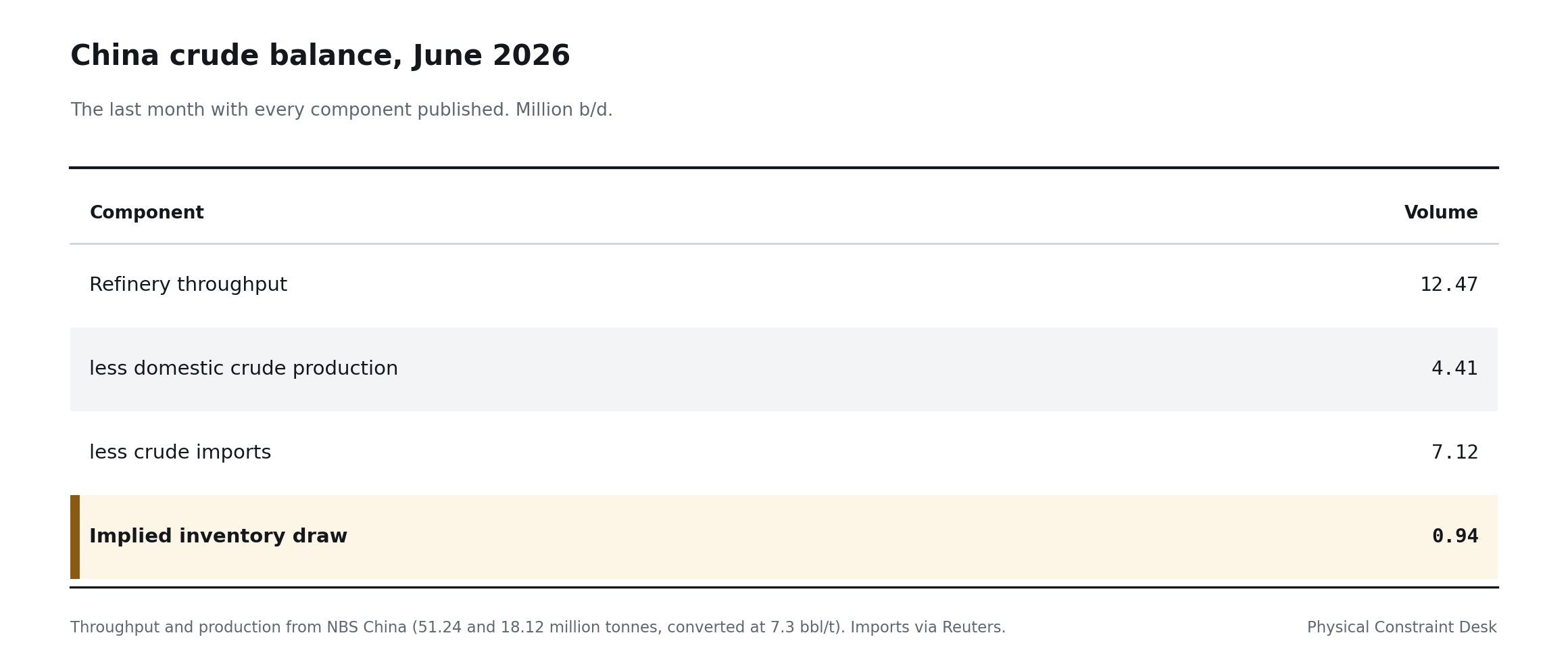
Start with June, because it is the last month where every component has been published. Refinery throughput was about 12.47 million b/d against domestic crude production of about 4.41 million and imports of 7.12 million. That leaves an implied inventory draw near 0.94 million b/d. Runs collapsed alongside imports, which is why a four million b/d fall in buying cannot be read as four million b/d coming out of tanks. That is why a depletion clock that treats the import gap as inventory draw materially overstates the draw.
The forward question is narrower and harder: how much crude can physically arrive. July's 8.41 million b/d is a customs total and it includes pipeline barrels. In Kpler's seaborne series, which excludes pipeline barrels and gives a like-for-like maritime-flow comparison, China took 6.94 million b/d in July against 11.43 million in the three months to end-February. Reuters puts analyst estimates of Chinese crude stocks at at least 1.2 billion barrels, which helps explain how Beijing has sustained curtailed imports for months.
Run the balance forward and the answer moves with one input. Take 13.25 million b/d of throughput, hold domestic production at the June anchor of 4.41 million, and allow a sustainable draw of 0.50 million, which is what May actually delivered. The balance breakeven for refinery throughput then sits between 12.31 and 13.32 million b/d, depending on whether you believe 7.40 or 8.41 million b/d of imports can be physically executed.
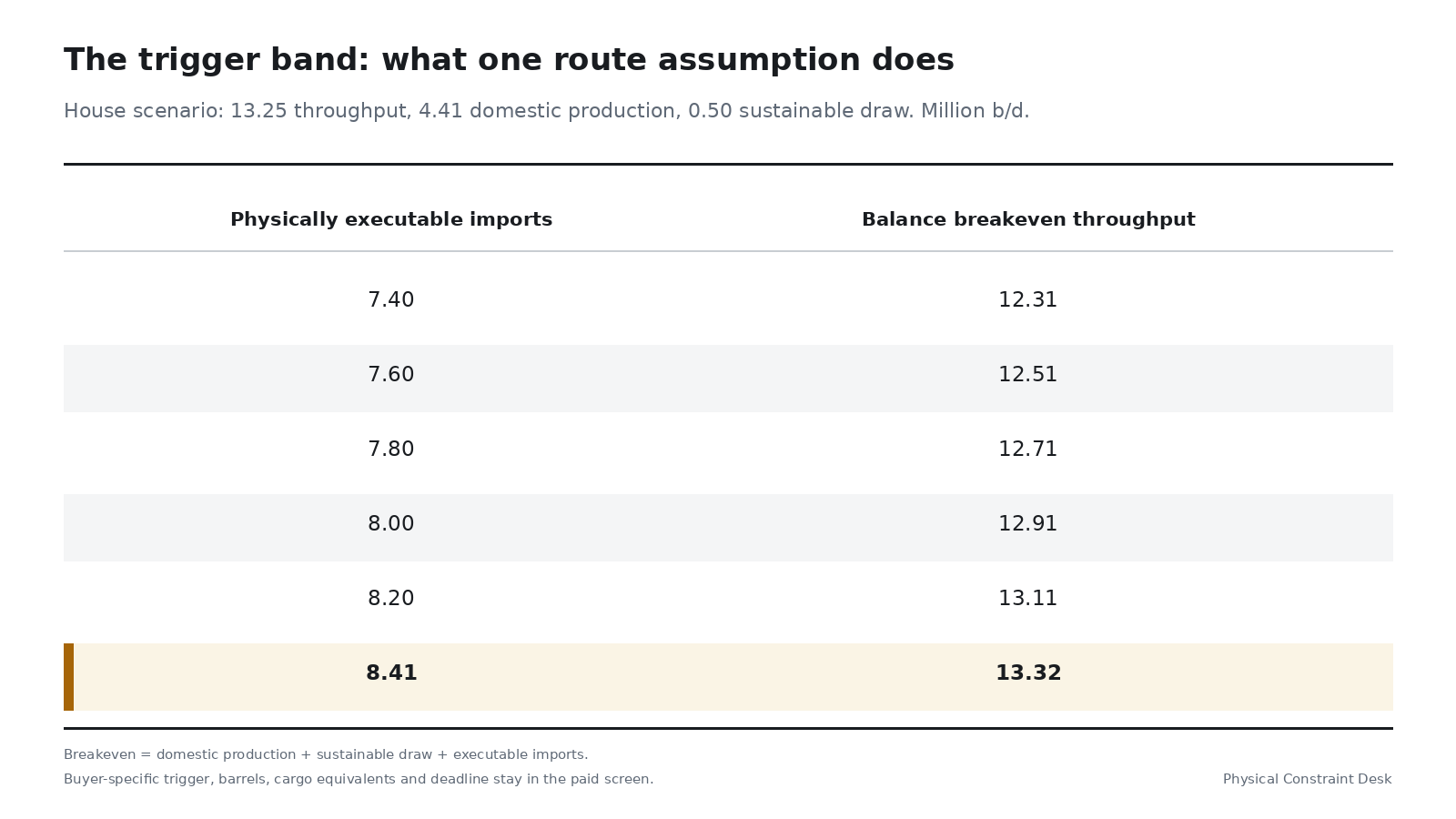
The highlighted row is the only case in this band where the 13.25 million b/d run-rate scenario is fully covered by the stated balance assumptions.
The run-rate scenario sits inside that band, which is an uncomfortable place to be. Assume the low end and China already needs barrels it is not currently taking. Assume the high end and it does not. Nobody publishes that assumption for you.
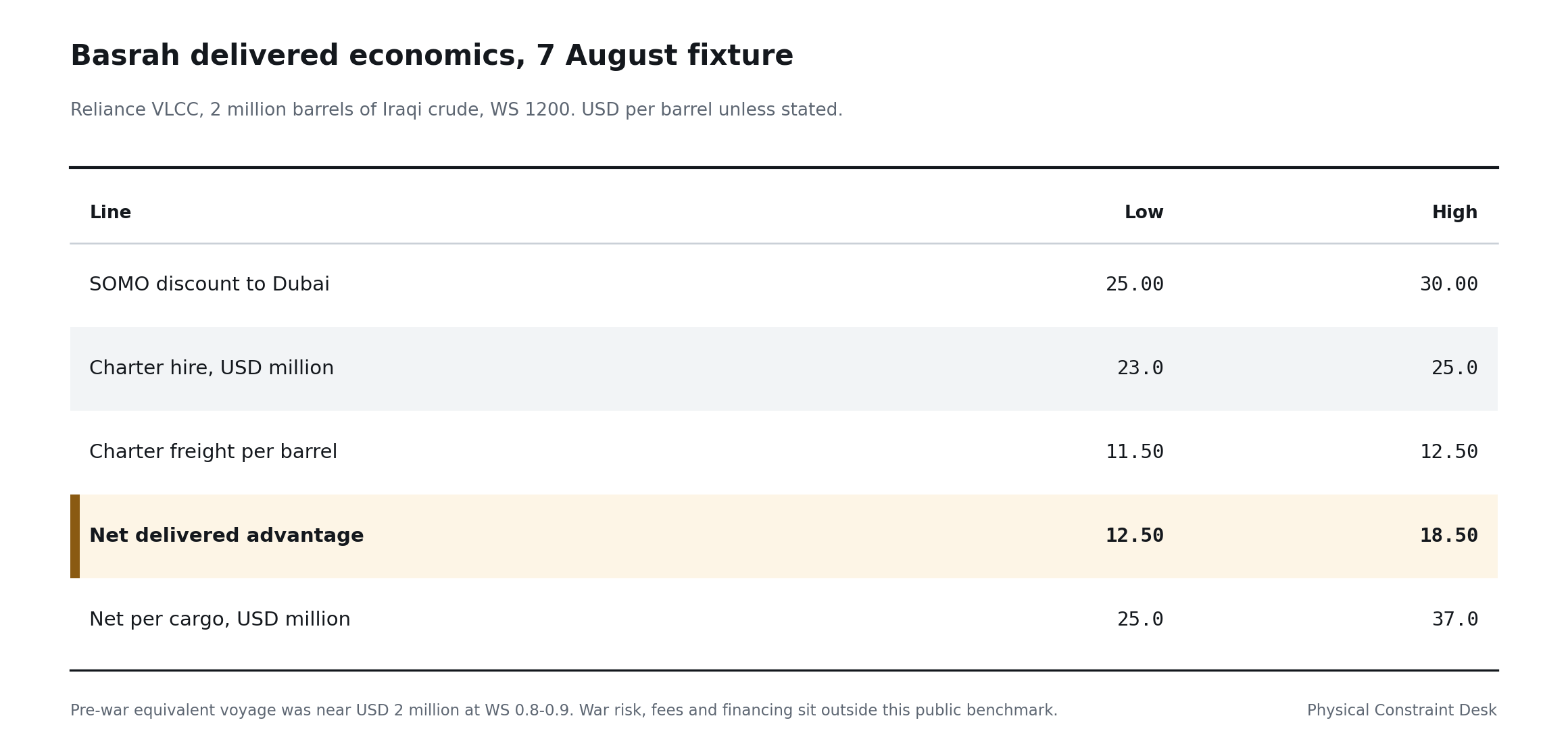
Freight is where the assumption stops being abstract. On 7 August Reliance fixed a VLCC for 2 million barrels of Iraqi crude at 23 to 25 million dollars, WS 1200, against roughly 2 million dollars for the same voyage before February. It still worked, because SOMO was discounting Basrah Heavy and Medium by 25 to 30 dollars a barrel to Dubai. On the freight midpoint that is about 12 dollars a barrel of cost against 27.50 of discount. What that tells a crude desk is that the crude discount can absorb extraordinary charter freight. The remaining constraint can still sit with vessel availability. Several other Indian and Chinese refiners were seeking ships in the same week while owners remained wary of entering the strait.
Current Hormuz status: Kpler reported on 10 August that Hormuz traffic stayed subdued through the past week and weakened into the weekend, with confirmed crossings falling from 15 on Friday to 11 on Saturday and 6 on Sunday, around half of them using the Iranian-approved northern route. For scale, the same tracker counted 33 crossings across four days in the week to 7 August, against a pre-war norm of 125 to 140 a day.
What would change this view: a signed Iran-Oman route arrangement that actually restores transits, an official August throughput print materially above 13.3 million b/d under the current house assumptions, or a visible narrowing of Basrah discounts. Any of those moves the answer, and I will say so here when it happens.
Sources:
- Reuters: China is balancing Asia's crude oil demand by itself
- Reuters: What is China's next surprise for oil markets
- Reuters: China did use crude stockpiles to ease Iran shock, not that much
- Reuters: Asia crude fuel imports recover, still shy of pre-Iran-war levels
- Reuters: China eases controls on fuel exports for second month
- Reuters: India's Reliance books supertanker at record freight price to lift Iraqi crude
- CNN: Iran war live coverage
- National Bureau of Statistics of China: press release
Gyula Toth | Physical Constraint Desk
Views expressed by independent contributors are their own and do not represent Matium.